
Cpamatica in 2026: CPA Network for Dating and Games, FLOW Smartlink and Weekly Payouts
Cpamatica enters 2026 as an established CPA network with more than a decade of experience in performance marketing, having marked its tenth anniversary in 2025. Its current affiliate offering remains centred on Mainstream Dating, Casual Dating and Games, supported by a catalogue of more than 1,000 active offers and relationships with over 300 advertisers. For affiliates, the practical points are not limited to the size of the catalogue: Cpamatica provides several commission models, accepts a broad range of traffic sources, gives approved partners access to personal managers and operates its own FLOW Smartlink tool for testing several offers through a single traffic stream. Payments are scheduled weekly, although the exact minimum amount depends on the chosen payment method and new affiliates are subject to separate conditions before their first withdrawal. This makes it worth examining the individual terms rather than judging the network only by headline figures.
Cpamatica Offers and Core Verticals in 2026
As of September 2026, Cpamatica’s public affiliate information lists more than 1,000 active offers from over 300 advertisers. The main niches remain Mainstream Dating, Casual Dating and Games, rather than a very broad catalogue covering every possible affiliate sector. That focus is useful for publishers whose traffic already matches these subjects because account managers and campaign resources are concentrated around areas in which the company has long-standing experience. Cpamatica also maintains in-house dating products, which it describes as exclusive offers available without an intermediary commission. The company does not publish one fixed payout or conversion rate for an entire vertical because commercial terms differ by advertiser, country, traffic source and campaign. Affiliates therefore need to assess each offer separately instead of treating the catalogue size as an indication that every campaign is equally suitable for their audience.
The available remuneration models give affiliates several ways to monetise traffic. Cpamatica currently lists CPL arrangements, including SOI and DOI lead flows, alongside PPT, PPS and RevShare offers. In simple terms, a lead-based campaign pays when a user completes the qualifying registration action defined by the advertiser, while PPS is linked to a completed sale and RevShare gives the affiliate a share of qualifying revenue generated by referred customers. These models produce different cash-flow patterns. A lead campaign may generate conversions earlier in the funnel, whereas a sales or revenue-share campaign generally requires stronger user intent. The correct choice depends on the audience, acquisition cost and advertiser rules rather than on the highest advertised commission. Offer descriptions are particularly important because qualification criteria can determine whether a recorded conversion is ultimately accepted.
Cpamatica also accepts a wide variety of acquisition methods. Its current materials mention social media, native advertising, email, SEO, paid search, push notifications, pop and banner traffic, teaser placements, in-app traffic, member areas and several other sources. This does not mean that every source can be used for every campaign. Each advertiser can set its own permitted and prohibited traffic rules, and those campaign-level restrictions take precedence over the network’s general list of accepted sources. Spam, incentivised or motivated traffic, content locking and fraudulent or artificially generated conversions are prohibited. Affiliates working across several acquisition channels therefore need to check the conditions of the individual offer before launching traffic, especially when moving a successful campaign to a new source that has not previously been approved.
Dating and Games as Cpamatica’s Main Areas of Focus
Dating remains the most visible part of Cpamatica’s business. The network distinguishes between Mainstream Dating and Casual Dating and also works with newer formats within the wider social-discovery market. Its recent educational material has covered AI-based dating services as well as more conventional dating funnels, which indicates that the niche is continuing to change rather than remaining limited to traditional registration offers. Cpamatica’s in-house dating products are another significant part of this focus. According to the current affiliate information, these products are available directly through the network and include offers aimed at the US market. Exact campaigns can change, so a specific brand or payout mentioned in older material should not automatically be treated as available in 2026. The live catalogue inside an approved account is the relevant source for current GEOs, caps, creatives and commercial conditions.
Games form the other named core vertical. Cpamatica does not present Games as an isolated section with one standard commission structure; instead, campaigns can use the same range of performance-based models found elsewhere in the network. This gives affiliates scope to compare fixed-action remuneration with arrangements such as PPS or RevShare where those options are available. For publishers, the important question is how closely a particular campaign matches existing traffic. A high nominal payout is less useful if the advertiser’s GEO, device requirements or conversion action do not fit the audience being sent to it. The offer catalogue, landing materials and reporting data therefore matter more than a general claim that one vertical converts better than another. Cpamatica’s own approach encourages testing individual combinations rather than assuming that a single campaign will perform identically across all sources.
Geographic reach is broad. On the advertiser side, Cpamatica states that its traffic coverage extends across more than 100 countries, while the affiliate section describes the offer base as worldwide. This does not imply that every offer accepts traffic globally. Dating and Games campaigns are commonly restricted to specific countries or groups of countries, and performance may differ considerably between GEOs because of language, purchasing behaviour, advertising costs and the user journey after the click. Affiliates should therefore compare campaign conditions by country and use localised creatives and landing routes where available. This is also one of the areas where FLOW becomes useful: rather than building a separate traffic link for every early test, an affiliate can group selected offers and then compare how the traffic performs across several combinations.
How the Cpamatica FLOW Smartlink Works
FLOW is Cpamatica’s in-house campaign management and Smartlink tool. Its basic purpose is straightforward: an affiliate can select several offers from the catalogue, add them to one Flow and generate a unique tracking link for the traffic stream. Cpamatica states that traffic can then be distributed between the selected offers, landing pages and pre-landing pages. This reduces the need to create a completely separate external link structure each time an affiliate wants to compare several suitable campaigns. FLOW is particularly relevant when there is enough traffic to conduct a meaningful test, because it lets the affiliate measure several alternatives through the same overall setup. It should not be understood as a guarantee that the network will automatically turn an unprofitable source into a profitable one; its value comes from giving the affiliate a practical way to collect and compare campaign data.
The setup process is deliberately simple. The affiliate chooses relevant offers from the directory, adds them to FLOW, creates the unique link and starts sending the intended traffic through it. The initial distribution allows several offers to receive traffic rather than forcing the affiliate to commit the entire test budget to a single campaign at the start. Performance can then be reviewed and weaker combinations can be removed while stronger ones receive more attention. Cpamatica also states that highly targeted flows can be created according to parameters such as device type and operating system. GEO and landing-page performance can be compared as well. In practical terms, this means a mobile audience from one country does not have to be evaluated in exactly the same way as desktop traffic from another country if the available offers and user behaviour differ.
Reporting is an important part of the process because FLOW provides statistics for the individual offers included in the Smartlink. Affiliates can compare offers, landing pages, countries and devices rather than relying only on an overall revenue figure for the entire traffic stream. EPC can be useful in this context because it shows how much revenue the traffic is producing relative to the clicks sent, but it should be assessed together with conversion rate, acquisition cost and sample size. A result based on a small number of visitors can change quickly and should not be treated as proof of long-term performance. FLOW therefore makes most sense as a testing and traffic-management tool: it simplifies comparison, while the affiliate still needs to decide which campaigns deserve additional traffic and which should be removed from the test.
What FLOW Can Improve and What Affiliates Still Need to Manage
One of FLOW’s clearest uses is reducing fragmentation during offer testing. Without a Smartlink structure, an affiliate testing several campaigns may need separate tracking links and traffic allocations for each one. FLOW lets selected offers sit within the same campaign flow, which can make it easier to compare results under similar traffic conditions. This is especially useful when several offers target the same broad audience but use different landers, conversion actions or advertiser funnels. The benefit is not simply convenience. Sending comparable traffic to more than one suitable option can reveal that an offer with a lower headline commission produces better revenue because more users actually complete the required action. Conversely, a high-paying offer can turn out to be inefficient if its conversion process is too demanding for the traffic source being tested.
FLOW does not remove the need for campaign discipline. Affiliates still have to choose relevant offers, control traffic quality, check advertiser restrictions and decide when the available data is strong enough to justify a change. A Smartlink that contains poorly matched campaigns will not solve the underlying targeting problem. The same applies to localisation: if a campaign accepts a particular country but its creative or landing route does not fit the language and expectations of the audience, routing traffic through FLOW does not automatically correct that mismatch. The tool is most useful when the initial campaign selection already makes commercial sense and the affiliate wants a cleaner way to compare alternatives. This distinction matters because optimisation software can organise testing, but the quality of the test still depends on the traffic and campaign choices made by the affiliate.
Compliance also remains attached to each individual offer. Cpamatica’s general rules allow many traffic types, but an advertiser can impose narrower conditions, so including an offer in FLOW does not override those conditions. The network can reject leads that do not meet offer criteria, come from users who were already customers where that is relevant, or are generated through automated or fraudulent methods. This creates a practical reason to keep traffic streams clearly segmented: if several sources with very different quality are mixed together, it becomes harder to understand which one caused rejected conversions or weak advertiser feedback. Affiliates who intend to scale a successful Flow should therefore monitor not only revenue but also approval quality and communication from their manager. Sustainable performance depends on conversions remaining valid after the advertiser’s checks, not merely appearing in the reporting interface at the moment they are generated.
Weekly Cpamatica Payouts and Payment Conditions
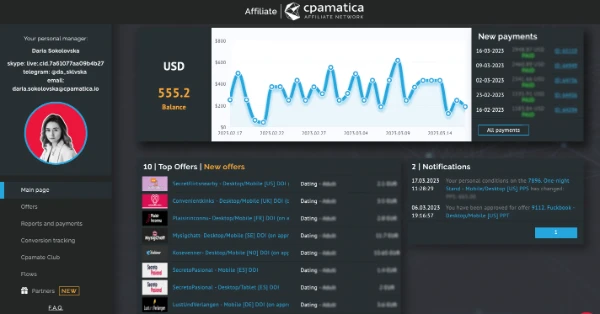
Cpamatica’s weekly payment schedule is one of its most clearly documented operational terms. The current FAQ states that Thursday is the designated payday. Invoices are generated on Wednesday and reflect the balance recorded through the end of Tuesday, after which the network aims to process supported payment methods on Thursday unless a payment provider causes a delay. The rules are different for a new affiliate’s first payment. Cpamatica states that payments begin 15 days after the affiliate receives the first lead from an advertiser and that the first withdrawal requires a minimum balance of $300. Once that initial payment has been completed, subsequent withdrawals move to the normal weekly schedule. This distinction is important because a new account should not assume that the standard Thursday cycle applies immediately after its first conversion.
Minimum withdrawal amounts also need careful reading. Cpamatica’s general affiliate page says that minimum payouts start from $50, but its detailed FAQ currently publishes higher method-specific thresholds. As of September 2026, those figures are $60 for Payoneer, $100 for Paxum in EUR or USD, $500 for PayPal, $150 for Capitalist, $300 for cryptocurrency and $1,000 for a wire transfer. The separate $300 requirement for the first payment also applies to new webmasters as described in the FAQ. Because these figures affect cash flow directly, the detailed payment section and the conditions visible in the affiliate account should be treated as more useful than a general “starts from” statement. An affiliate choosing a payment method should consider not only availability but also how quickly the expected earnings are likely to reach the relevant threshold.
Processing is not necessarily instantaneous even when Cpamatica sends a payment on Thursday. The FAQ says a transaction can take up to three working days. It gives typical maximum estimates of up to 48 hours for Paxum, Payoneer, PayPal, Capitalist and cryptocurrency payments, and up to 72 hours for wire transfers, while noting that many transactions are completed on the same day. External factors such as bank processing, local rules, holidays or payment-provider issues can extend the timetable. A payment can also be held when account payment details are missing, when there are too few leads to complete a traffic-quality assessment or when suspected fraudulent patterns require investigation. Cpamatica says a deeper traffic review can take up to seven days, although it states that such checks usually take only a couple of days.
Affiliate Support, Cpamate and Who Cpamatica Is Best Suited To
Approved affiliates receive a personal manager, which is relevant because many important campaign conditions cannot sensibly be reduced to a public list. Managers can help with available offers, traffic-source approval, landing materials and requests for campaigns that are not currently present in the catalogue. Cpamatica’s FAQ says its managers are usually available around the clock and refers to communication through Skype or Telegram, with email and a Telegram bot available as additional routes if the assigned manager cannot be reached. The wording “usually” is worth noting: this is not the same as a guaranteed immediate response at every hour. For affiliates managing paid traffic, the practical benefit is having a named contact who can clarify offer-level restrictions before significant spend is committed rather than relying on assumptions about what an advertiser permits.
Cpamatica also operates the Cpamate loyalty scheme. Current terms award one loyalty point for every $20 earned through Cpamatica offers, with points available for rewards listed in the Cpamate shop. The points are not cash and cannot simply be converted into a withdrawal balance. The network additionally runs a referral programme under which an affiliate can receive 2% of the earnings generated by a referred affiliate for 12 months from that person’s registration date. Self-referrals and referrals of family members are not allowed. These extras may have value for an established affiliate who already generates regular volume, but they should remain secondary when evaluating the commercial relationship. Offer quality, conversion approval, traffic compatibility and reliable payment conditions have a much greater effect on the economics of an affiliate campaign.
In 2026, Cpamatica is best viewed as a specialised performance-marketing network for affiliates working with Dating, Games and closely related traffic rather than as a universal catalogue for every niche. Its measurable strengths are a sizeable offer base, several commission models, broad traffic-source coverage, an in-house FLOW Smartlink, personal affiliate management and a documented weekly payment cycle. There are also conditions that need to be factored into planning: individual advertisers control their own traffic rules, conversions can be rejected when they fail campaign requirements, the first payment has a separate $300 condition and later minimum withdrawals vary substantially by payment method. For an affiliate whose audience matches the network’s core verticals, the practical test is therefore straightforward: compare appropriate offers, use FLOW where multi-offer testing is useful, monitor approved rather than merely recorded conversions, and base scaling decisions on verified campaign data.